1 Chapter 1 - Basics of Business Strategy
1.1 Introduction to Strategy
We all have an idea about what a strategy is. However, few of us can clearly explain it. We can say that a strategy is a “smart” or effective way of doing something, usually something that is not easy to do. We also have an intuition about what a business strategy is: transferring what we know about strategy to the organizational context, we can imagine that a business strategy is a set of methods or actions designed to improve the bottom line of the organization — sales and profits.
Developing and implementing a successful business strategy is one of the most complex tasks (if not the most complex task) of a manager or executive. In a globally competitive environment, a successful business strategy can make the difference between a company thriving and a company disappearing. Unfortunately, becoming a manager who reliably crafts and deploys good strategies takes a long time, and only real-world experience will get you there — including making mistakes and learning from them. However, if you learn the basic distinctions behind elaborating and implementing a business strategy, you will be in a much better position when you make real strategic decisions for a company, whether it is someone else’s or your own.
In this chapter we explore this “intuitive” concept of business strategy that seems easy to grasp but is very difficult to apply in the real world. Difficult concepts are better explained with examples, so we first present a simple example that shows why managers cannot apply a purely rational way of thinking when elaborating a business strategy. We then define business strategy along with business objectives, the strategic management process, and the process of formulating a strategy.
1.2 Can we think rationally when elaborating a strategy?
When we have to make an important decision, we usually try to think rationally. Thinking rationally implies considering all possible alternatives, evaluating each one objectively, and only then making a decision. But is that even possible?
Imagine you are a soccer coach. How many different teams could you send onto the field if you have to pick 11 players out of a squad of 15? (Two teams are “different” if at least one player is replaced.) If you do the math — this is the formula for combinations — the answer is 1,365 different teams, and that is before deciding who plays which position.1
Besides deciding which 11 players start the game, you also have to decide the exact configuration of positions — who plays where. How many different team configurations can be formed from these 15 players? Now order matters, so we need the formula for permutations.2
Doing the math, you get 54,486,432,000 different team configurations — more than 54 thousand million. To get a feel for that number: if you evaluated one configuration per second, without ever sleeping, it would take you about 1,700 years to review them all. And that is with a 15-player squad. With 25 players the number jumps to more than 1.7 \times 10^{14} — 170 million millions — which at one per second would take longer than the age of the human species.
On top of that, you have to make many decisions during the game according to a “strategy”: being more defensive or more offensive, specific tactics per player, how many substitutions to make, when to make them, and so on. Once we account for all of these, the total number of possible outcomes becomes absurdly large.
In this context, a coach has to a) have a clear vision of the game, b) know his or her team’s strengths and weaknesses, c) know the opposing team, d) set objectives — in this simple context, to win the game, e) craft a strategy according to those objectives, and f) implement and execute the strategy. During implementation the coach makes many further decisions: selecting the players that best match the strategy, defining the “tactics” to follow during the game, and staying alert to contingencies and unexpected outcomes so as to react quickly and effectively.
What is the best way to decide each of these lines of action? Many people would answer that one should think in a purely rational way — considering all possible outcomes before deciding. Do you think that is feasible for a coach? Our combinatorial exercise says it is not: there is not enough time in a human lifetime to enumerate the alternatives, let alone evaluate them. So what process does a coach actually follow? Coaches rely on bounded rationality: they evaluate a small number of plausible options informed by experience, pattern recognition and intuition, and they adjust as the game unfolds. Rational analysis matters, but it operates on a shortlist that experience has already produced.
1.3 Defining Business Strategy
Now, moving to the organizational context — the business world — do executives face the same level of complexity as sports coaches when formulating and implementing a strategy? In fact they face considerably more. The number of possible states an organization can be in is far larger than in a soccer game. In a soccer game the time frame is 90 minutes; in an organization there may be no deadline at all. In a soccer game the objective is unambiguous — score more valid goals than the other team; in business, several objectives coexist and sometimes conflict with each other (growth versus profitability, market share versus margin, short term versus long term).
However, the decision making process is similar for both cases. The decision maker has to have a clear vision, know his or her company’s weaknesses and strengths, know about the competition, then set objectives accordingly, craft a strategy to achieve these objectives, and finally, implement/execute the strategy.
An organization’s strategy is a combination of a general line of actions and business approaches that executives and/or managers define in order to achieve business objectives, be competitive in the market, and constantly attract customers. The execution of the strategy in an organization usually involves many operational daily decisions made by different executives, middle managers, and employees.
A business strategy has to be aligned to the business model of the company. A business model specifies what the business sells and how it makes profits. The process that managers and executives follow to create a business strategy is called strategic management process. Before examining in detail the strategic management process, we need to define what a business objective is.
1.4 Business Objectives
A business objective is a statement that clearly specifies a future business achievement. A well-written business objective must have the following characteristics: a) be specific (S) and clear, b) be measurable (M), c) be attainable (A), d) be relevant (R), and e) be timely (T). These characteristics are usually labeled as “SMART”. What do these characteristics mean?
An objective is specific if it clearly states which results or outcomes will be obtained and, if relevant, to whom the achievement is directed. It is measurable if it names numeric indicators — usually key performance indicators — so that its achievement can be verified rather than debated. It is attainable if it is feasible within the stated time frame given the company’s resources. It is relevant if it is aligned with the company’s mission and vision. It is timely if it explicitly states when the company will achieve it.
Compare these two statements:
❌ “Increase our sales significantly next year.” — not specific (increase where? for which product?), not measurable (“significantly” is not a number), and only vaguely timely.
✅ “Increase revenue from the small-business segment in Mexico by 15% between January and December 2027, without reducing gross margin below 32%.” — specific, measurable, time-bound, and it makes the trade-off explicit.
The second statement is harder to write, and that is precisely the point. A well-written objective forces the management team to agree on what success means before the strategy is designed.
1.5 Strategic Management Process
When elaborating a business strategy, it is easy to get confused between business objectives and business strategies. Business objectives basically specify which will be the future achievements of the company and must be “SMART”. A business strategy is a general line of actions and approaches designed to achieve the business objectives. To elaborate a well designed business strategy it is recommended to follow a strategic management process:
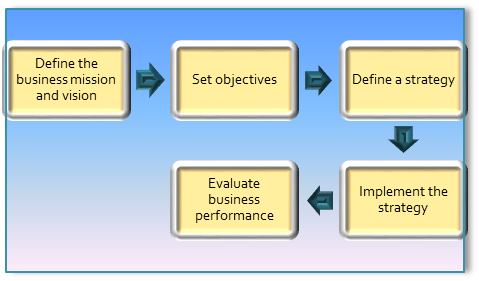
The business mission states what the company is about and what type of products or services it offers. The business vision states where the company is headed in the near future. The objectives translate that vision into a concrete set of results and performance indicators that move the company toward it. The strategy is the general line of action, together with the business approaches, tailored to achieve those objectives.
A useful way to remember the sequence: mission answers who we are, vision answers where we are going, objectives answer how we will know we got there, and strategy answers how we will get there.
The implementation of the strategy usually is a complex process in which all employees are involved and is reflected in business operations, which in turn impact business performance –the bottom line of the company. During and after a business strategy is implemented, specific key performance indicators should be used to monitor how the strategy is contributing to accomplish business objectives. Several methodologies can be used in this monitoring process such as Balance Score Card, surveys to measure customer or employee satisfaction, financial ratio analysis, etc. These methodologies are vast and well documented, but for now keep in mind that it is a good habit to measure and interpret financial performance during and after a strategy implementation.
A business strategy is usually formulated at different levels, depending on the size of the company. In large corporations there is typically a) a corporate-level strategy, b) business-level strategies, c) functional-level strategies, and d) operating-level strategies. In the US, public companies (firms that issue stock in a financial market) must file financial and operational reports periodically, and their annual report — Form 10-K — includes a description of the business and its strategy. Because these filings are public and freely available in the SEC’s EDGAR database (https://www.sec.gov/edgar), competitors read them too. That is precisely why firms describe their strategy in general terms and keep the operational detail confidential. Still, it is illustrative to see how they frame it. Here is Apple Inc.’s business strategy as stated in its 2018 annual report (Form 10-K for fiscal year 2018):
The Company is committed to bringing the best user experience to its customers through its innovative hardware, software and services. The Company’s business strategy leverages its unique ability to design and develop its own operating systems, hardware, application software and services to provide its customers products and solutions with innovative design, superior ease-of-use and seamless integration. As part of its strategy, the Company continues to expand its platform for the discovery and delivery of digital content and applications through its Digital Content and Services, which allows customers to discover and download or stream digital content, iOS, Mac, Apple Watch and Apple TV applications, and books through either a Mac or Windows personal computer or through iPhone, iPad and iPod touch® devices (“iOS devices”), Apple TV, Apple Watch and HomePod. The Company also supports a community for the development of third-party software and hardware products and digital content that complement the Company’s offerings. The Company believes a high-quality buying experience with knowledgeable salespersons who can convey the value of the Company’s products and services greatly enhances its ability to attract and retain customers. Therefore, the Company’s strategy also includes building and expanding its own retail and online stores and its third-party distribution network to effectively reach more customers and provide them with a high-quality sales and post-sales support experience. The Company believes ongoing investment in research and development (“R&D”), marketing and advertising is critical to the development and sale of innovative products, services and technologies. 3
This is an example of a corporate-level strategy. Notice what it does and does not say. It names the source of competitive advantage — the integration of hardware, software and services — and the mechanisms that sustain it (owned retail channel, third-party developer ecosystem, sustained R&D investment). It does not name a single product roadmap item, price point or target market share. That is the disclosure trade-off in action: enough for investors to understand the logic, not enough for a rival to copy the plan.
In the case of Mexican public firms, annual reports can be downloaded from the Mexican Exchange, Bolsa Mexicana de Valores (https://www.bmv.com.mx). For example, the 2016 annual report of Grupo Alfa, S.A.B. de C.V. states the following business strategy:
ALFA ha venido desarrollando una estrategia que busca capturar las oportunidades de crecimiento que le brindan sus negocios actuales y aquéllos relacionados, ya sea de manera orgánica o por adquisiciones. Al efecto, las empresas de ALFA elaboran planes de inversión que permitan alcanzar los objetivos señalados, aprovechando las habilidades que ellas han desarrollado con el tiempo. ALFA estudia los supuestos macroeconómicos y de negocio en que se basan los planes de inversión de sus empresas, asegurándose de Reporte Anual 2016 12 alcanzar las metas financieras establecidas. También, vigila que dichos planes individuales armonicen con sus propios objetivos estratégicos de largo plazo. Para la autorización de los proyectos de inversión de sus empresas, ALFA sigue una estricta disciplina. Al efecto, ALFA ha establecido parámetros de rentabilidad mínima de proyectos, así como de niveles de apalancamiento máximo, buscando el uso eficiente del capital dentro de un marco de riesgo financiero adecuado. Además de los proyectos de inversión de sus empresas principales, y dada su naturaleza de empresa controladora, ALFA analiza constantemente oportunidades para maximizar el valor del capital de sus accionistas, a través de manejar en forma dinámica su portafolio de negocios. Así, frecuentemente se analizan potenciales adquisiciones en los negocios relacionados, o en otros donde pueda aprovechar sus fortalezas. 4
1.6 Formulating a business strategy
Formulating a business strategy is one of the most complex and important tasks of a manager. The most important issue to address is competitive advantage: a business strategy must clearly state how the company creates and sustains it, how the company develops organizational capabilities, and how those capabilities in turn feed the competitive advantage.
Once we know what the strategic management process is, the big question becomes how to formulate the right strategies. Before formulating a strategy, executives need to understand the external environment — who the company’s stakeholders are, what the industry value chain looks like, including customers, suppliers and competitors — and the internal factors — organizational capabilities, and the current situation of the company in terms of financial facts and human capital. External stakeholders, market and industry trends, and regulation have to be monitored constantly through environmental scanning techniques. From the external environment we identify threats and opportunities; from the internal factors we identify strengths and weaknesses. This process is known as SWOT analysis (Strengths–Weaknesses–Opportunities–Threats).
SWOT analysis helps a company use its internal strengths to a) capitalize on external opportunities and b) cope with external threats. Identifying weaknesses helps the company plan improvements in human capital, or simply adjust its objectives accordingly.
A common mistake is to label as a weakness something that is really an external threat. The distinction is this: strengths and weaknesses are attributes of the internal capabilities of employees, teams, executives or business units — things the company controls. Threats and opportunities live outside the company. For example, if a competitor launches an innovative product that is cheaper and better than your flagship product, it is tempting to write down “we are not innovative enough” as a weakness. The competitor’s launch itself is an external threat. The internal weakness, stated properly, would be something like “our R&D team lacks experience in embedded software”, because that is an attribute of our people that we can act upon.
Ask: “Could this still be true if my competitors did not exist?” If yes, it is internal (a strength or a weakness). If no, it is external (an opportunity or a threat). Ask also: “Can we change it directly with a management decision?” Internal items are actionable; external ones can only be responded to.
In the Appendix A, I suggest a practical guide to perform analysis when formulating a business strategy.
It is important to define what competitive advantage is. A competitive advantage is an attribute of a company, or of its products and services, that is a) valuable to the customer, b) perceived as unique, and c) difficult to imitate. Because of intense competition and the rapid diffusion of communication technologies, it is hard for a company to sustain a competitive advantage over time, so a firm must continually work to make its products or services difficult to copy. This sounds simple and is extremely hard in practice.
- “We use cloud computing.” — Valuable, but not unique and trivially imitable. Not an advantage; it is a cost of doing business.
- “Our delivery is 24 hours faster than anyone else’s in the region.” — Valuable and unique, but is it hard to imitate? Only if it rests on something a competitor cannot quickly replicate, such as a distribution network built over a decade.
- “Every additional user makes our product more useful to every other user.” — Valuable, unique and self-reinforcing. Network effects are among the most durable advantages precisely because a rival must replicate the entire user base, not just the technology.
The third bullet illustrates the key test: an advantage is durable when imitating it requires imitating the history that produced it, not just the current state.
1.7 Stating the competitive advantage — Porter’s theory of competition
To know whether a specific mix of products and services can give a company a competitive advantage, we need to understand the industry and the external forces that shape profitability. Intuitively, you need to know your competition before you can identify your advantage. When we think about competitors, we usually picture one or two direct rivals. However, as Michael Porter argued, before we can understand competition we need to study the whole industry structure: not only rivals, but also suppliers, customers, potential new entrants and substitute products. Porter first laid out these forces in 1979 and developed them fully in Competitive Advantage (1985); the version cited here is his 2008 restatement (Porter 2008). The five forces are:
Threat of new entrants — how easy is it for a new competitor to enter the market? This is determined mainly by entry barriers. In the aerospace industry the barrier is very high: a new entrant needs enormous capital, highly specialized human capital, proprietary technology and regulatory certification. In food delivery apps the barrier is low, which is why margins there are thin.
Bargaining power of suppliers — if a supplier has many potential buyers for its product, the incumbent company (the supplier’s customer) has little leverage to negotiate prices and terms. Think of a small airline negotiating with Boeing or Airbus.
Bargaining power of customers — the more options a customer has for obtaining the same or a similar product, the less power the company has to set prices and terms. A supermarket chain buying from hundreds of small food producers has enormous buyer power.
Threat of substitute products — how easily can a customer satisfy the same need with a different kind of product at an attractive price? Note that substitutes come from outside the industry: video conferencing is a substitute for business air travel, not a rival airline.
Rivalry among existing competitors — how fierce is competition among direct and indirect competitors already in the industry?
As Porter puts it, “industry structure drives competition and profitability” (Porter 2008). Industry structure is determined by the strength of each of these five forces and by how they interact.
This framework explains something that a purely firm-level view cannot: why average profitability differs so persistently across industries. Software and pharmaceuticals have historically earned high returns on capital because entry barriers (intellectual property, R&D scale, regulatory approval) are high and substitutes are weak. Airlines and grocery retail earn thin returns because buyers are price-sensitive, suppliers are concentrated, and rivalry is intense. A well-run airline may beat a poorly-run one, but both operate inside the same structural constraint.
If a company identifies and understands these forces, it is in a better position to improve its competitive position — either by choosing where to compete, or by acting to change the structure itself.
1.8 Generic types of competitive strategies
Michael Porter defines five generic types of competitive strategy (Porter 2008) along two dimensions: the market target (a narrow market niche versus a broad market) and the type of competitive advantage (low cost versus differentiation). The following figure illustrates these five strategies:
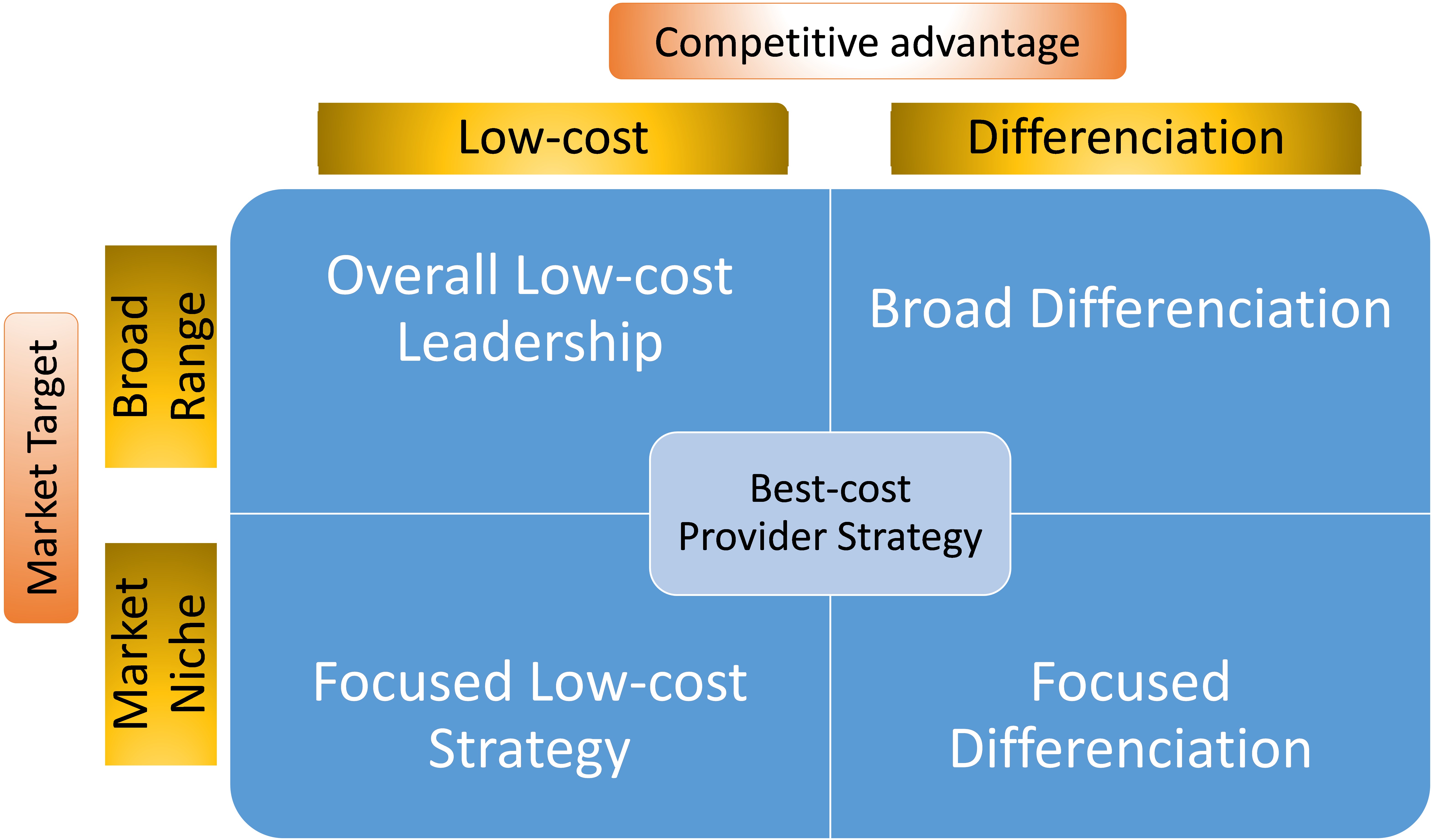
The differentiation strategy aims to offer unique features in products or services: superior service, innovative technology, high quality, distinctive design. These features allow the company to charge premium prices, grow sales and build customer loyalty. The low-cost strategy focuses on the operational efficiency that makes low prices possible while maintaining an acceptable level of quality. A low-cost company generates wealth through low margins on high volume sold to a broad market; a differentiator generates wealth through high margins justified by unique product features.
A critical warning that Porter emphasizes: a company that tries to be both, without being decisively better at either, ends up “stuck in the middle” — its costs are too high to win on price and its products are too ordinary to command a premium. Strategy is as much about what you deliberately choose not to do as about what you do.
Return on Assets (ROA) is a simple but important financial ratio that provides insight information about business strategy. ROA is equal to the ratio of Net Income (at the end of a period) to Total Assets (at the beginning of the period).
ROA_{t} = \frac{NI_{t}}{TA_{t-1}}
Net income is equal to total sales minus fixed and variable costs, and also taxes and financial expenses. Usually Net Income (NI) does not clearly reflect the capability of the firm to generate profits from operations since financial expenses and taxes can be manipulated following accounting rules. Compared with NI, Earnings before interest and taxes (EBIT) better reflects firm productivity. I will call ROABIT when ROA is calculated using EBIT instead of NI as numerator. We can separate ROA in two ratios if we multiply ROA times \frac{Sales}{Sales}, which is one. Let’s do some simple math to decompose ROA:
Multiplying ROA by Sales divided by Sales we do not change its value, but we can express ROA in terms of profit margin and asset turn over:
ROA_t = \frac{NI_{t}}{TA_{t-1}}*\frac{Sales_{t}}{Sales_{t}}
ROA_t=\frac{NI_{t}}{Sales_{t}}*\frac{Sales_{t}}{TA_{t-1}}=ProfitMargin*AssetTurnOver
In case of ROABIT:
ROABIT_t=\frac{EBIT_{t}}{Sales_{t}}*\frac{Sales_{t}}{TA_{t-1}}=OperatingProfitMargin*AssetTurnOver
Then ROA = (Profit Margin) × (Asset Turnover). This is the core of the DuPont analysis, a decomposition developed at the DuPont corporation in the early twentieth century by Donaldson Brown, and still one of the most useful tools in financial analysis.
Why does this decomposition matter for strategy? Because it shows that two companies can earn the same ROA through completely different business models — and that the model they choose is precisely their generic competitive strategy:
- A company following a low-cost strategy maximizes Asset Turnover: high sales volume, a broad market, low prices, and assets that are made to work hard.
- A company following a differentiation strategy maximizes Profit Margin: high prices justified by unique product features, even if each peso of assets generates fewer pesos of sales.
Here is a stylized numerical illustration of two firms with identical ROA:
| Discount supermarket | Luxury watchmaker | |
|---|---|---|
| Sales | $100,000 | $10,000 |
| Net income | $2,000 | $2,500 |
| Total assets (beginning of year) | $25,000 | $31,250 |
| Profit margin = NI / Sales | 2.0% | 25.0% |
| Asset turnover = Sales / TA | 4.00 | 0.32 |
| ROA = Margin × Turnover | 8.0% | 8.0% |
Both firms earn 8% on assets, but the supermarket gets there by turning over its assets four times a year on a razor-thin 2% margin, while the watchmaker turns over its assets less than once a year on a 25% margin. Now the strategic implication becomes clear: the two firms are vulnerable to completely different things. A 1-percentage-point drop in margin wipes out half of the supermarket’s ROA; the watchmaker would barely notice. A slowdown in inventory turnover devastates the watchmaker’s already-low turnover; the supermarket has room to absorb it.
This is a first, very concrete example of a theme that runs through this whole book: decomposing an aggregate number into its components turns a description into a diagnosis. ROA alone says “8%”. ROA decomposed says “this is a volume business” or “this is a margin business”, and that tells the manager where to look.
Note that low-cost companies also work hard to control costs — that raises margin too — but the dominant source of their ROA is turnover.
We can now redefine competitive advantage as superior performance driven by differentiation, cost efficiency, or both. To understand where that advantage comes from inside a company, we must analyze its key internal activities. That is why we turn to value chain analysis.
1.9 Value chain analysis
Value chain analysis is a method for studying how each business activity of an organization contributes to creating value. The framework classifies activities into two groups:
Primary activities — those that directly add value to the core products or services: inbound logistics, operations, outbound logistics, marketing and sales, and service.
Support activities — those that add value indirectly by enabling the primary activities: firm infrastructure, human resource management, technology development, and procurement.
The purpose of the analysis is not to list the activities but to ask, for each one, two questions: does this activity make us cheaper than rivals, or does it make us different from rivals? An activity that does neither is a candidate for outsourcing or elimination. From this perspective it becomes easy to visualize how a business strategy enhances both efficiency and effectiveness.
The following figure illustrates an organizational value chain with examples of information technology innovations that can support each activity.
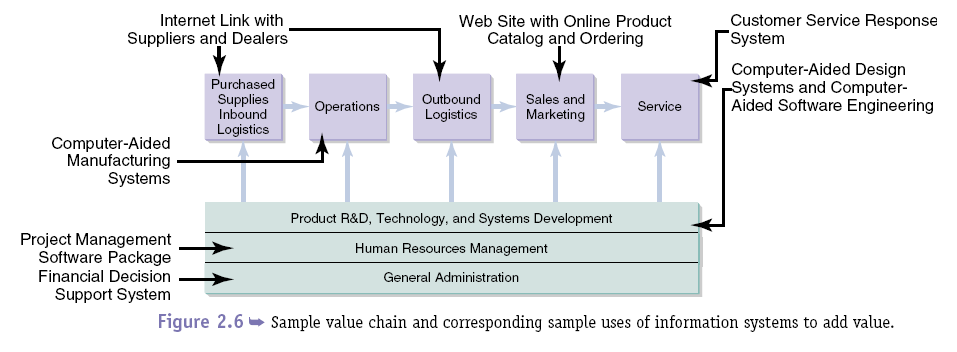
We can define the value chain as the sequence of all activities an organization performs in order to design, produce, sell, distribute, deliver and support its products and services. The figure shows examples of strategies — here focused on information technology — that improve the efficiency or effectiveness of each activity. IT can significantly improve business performance, so it should always be considered when developing a strategy. This analysis makes it possible to see the current state of IT in an organization and which IT initiatives would matter most.
To distinguish efficiency from effectiveness, I like Peter Drucker’s formulation: efficiency is “doing things right”, while effectiveness is “doing the right things”. He drew the same distinction between management and leadership. The order matters: being highly efficient at the wrong activity is worse than being moderately efficient at the right one, because efficiency makes you travel faster in whatever direction you have already chosen.
Value chain analysis helps us understand the internal operations of a company and identify where it can innovate — in any primary or support activity — in order to become more efficient, more effective, or both.
1.10 Blue ocean: a different approach to business strategy
Besides the well-known school of thought proposed by Michael Porter, a more recent perspective was proposed by INSEAD professors Chan Kim and Renée Mauborgne (Kim and Mauborgne 2005).
They propose a way of formulating strategy centered on value innovation. Think of the existing marketplace plus every potential marketplace as one whole ocean. Red oceans are the existing industries where competitors fight over the same demand, turning the water red. Blue oceans are the market spaces no competitor has explored yet. The key to an effective strategy, they argue, is to create a blue ocean — through innovation not only in products but also in services and business processes.
The distinctive move in their framework is to reject the trade-off between differentiation and low cost. Instead of accepting the industry’s standard bundle of features, a firm asks four questions: which factors that the industry takes for granted should be eliminated? which should be reduced well below the standard? which should be raised above it? and which should be created that the industry has never offered? Eliminating and reducing lowers cost; raising and creating adds value. Done together, they can deliver differentiation and low cost simultaneously.
Although this resembles Porter’s differentiation strategy, the two frameworks differ in how they see the relationship between strategy and structure. Porter’s perspective puts more weight on the outside of the company: strategy must be defined in response to external forces that the firm does not control. The blue ocean perspective puts more weight on the inside — on the capability to innovate — and assumes that a sufficiently powerful strategy can reshape the environment rather than merely adapt to it.
Both perspectives are useful. Depending on the situation of the company and the industry environment, you can apply either one or combine them into an integrated strategic view. A reasonable heuristic: use Porter’s forces to understand why your industry is as profitable as it is, and the blue ocean questions to challenge whether you have to stay inside it.
1.11 Managers’ decision-making process
It would be wonderful to have a recipe for formulating and implementing effective business strategies. Unfortunately no such recipe exists, and this cannot be fully taught in the abstract. A manager learns to formulate effective strategies by acting and learning from the results.
There is an interesting perspective on human behavior called the observer model, proposed by Fernando Flores and refined by Rafael Echeverría (Echeverria 1995). The following figure illustrates it:
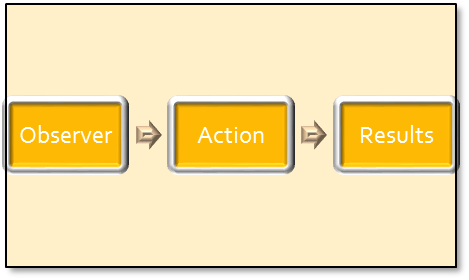
According to this model, our actions are determined by the way we see and interpret the world (our “observer”), and our results depend directly on our actions. From this model a theory of learning follows. When we take certain actions and get certain results, we can try to improve by changing our actions and seeing whether the results improve. This is first-order learning. But there is a far more powerful route: changing the observer — changing the way we perceive the world in the first place. This is second-order learning. We change our observer when our paradigms shift; a paradigm being a strong belief shared by the people we habitually interact with.
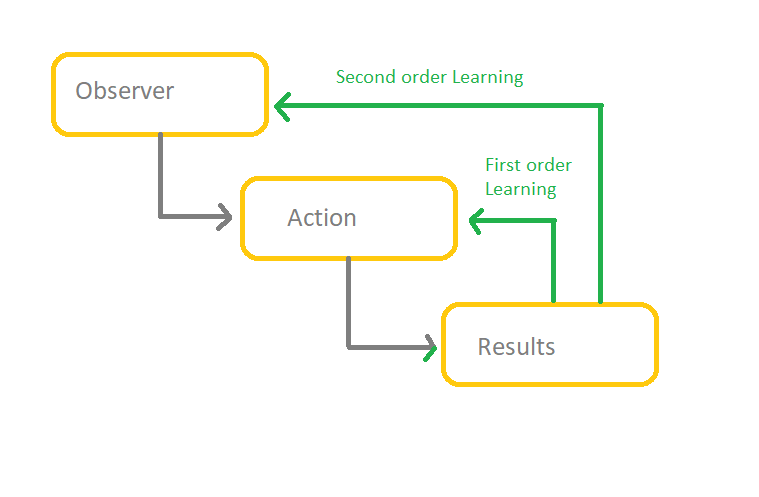
The distinction matters for strategy. First-order learning asks “how do we sell more of this product?” Second-order learning asks “are we even in the right business?” Kodak’s engineers were superb at first-order learning about film. The blue ocean framework in the previous section is, in effect, a set of tools for forcing second-order learning.
Our “observer” is formed over time and shapes our beliefs, while our habits of action are built by trial and error. Managers who become genuinely expert at formulating and implementing strategy usually share one trait: a great ability to change their observer as the environment and the organization’s capabilities change.
1.12 Appendix A. Practical guide for case analysis to write a strategic plan
As mentioned above, formulating a business strategy is among the most complex tasks a business professional faces, and the best way to learn it is by practicing with real cases. It helps enormously, however, to first internalize the concepts in this chapter and then practice on invented cases or on a business you know well. This guide suggests a simple but effective structure for a case analysis and a clear, coherent strategic plan for any organization. It is not the definitive guide — the best guide will be the one you build yourself out of your own knowledge and experience.
| Section | Brief description | What you have to WRITE |
|---|---|---|
| 1. Business and Industry FACTS. | For the internal information, you have to analyze current and recent financial situations, current organizational structure. Look for the important PROBLEMS or CHALLENGES the company is facing. For the external information, you have to do your own research to identify the most important facts of the market, the industry and government regulations. | 1. Firm Highlights — write relevant financial and non-financial highlights. You can consider financial highlights related to: a) Growth b) Profitability 2. Industry overview — relevant statistics about the industry (e.g. market shares, main players, etc). According to the case, you can apply any of the tools described in the note such as the “5 forces”, value chain analysis, etc. (If you do not have any information about the industry, consider assumptions) |
| 2. ASSUMPTIONS | You have to explicitly state your assumptions for the information you could not obtained, and also your own perceptions about the current situations. Only state the assumptions you consider important for your strategy formulation you are about the develop. | 1. Assumptions related to the Firm. For example, here you describe the internal strength and weaknesses you think the company have. Remember that strength and weaknesses are related to the people capabilities, not to the current situation of the products or external threats. Also, you can state important problems you perceive the company has to face. 2. Assumptions related to the industry. Here you can make assumptions about competitors, government regulations, etc. 3. Assumptions related to the target market. Here you can describe the target market in terms of demography, customer profile, regions, etc. |
| 3. BUSINESS OBJECTIVES – Short and Long-term objectives | According to your facts and assumptions where you clearly identify the main problems and challenges, state a few “SMART” business objectives. State between 1 to 4 short-term and other 1 to 4 long-term objectives. You can classify the objectives into two types: a) business growth b) business profitability. |
You have to write a list of short-term and long-term SMART objectives. You can list them in a table with a classification of: a) Growth b) Profitability objectives. |
| 4. Short-term and long-term STRATEGIES | According to the objectives, you have to explain the short-term and long-term strategies you propose to reach these objectives. | You can write first a list of the short-term and long-term strategies indicating to which business objective each strategy is tailored. You can do this in a table. Then, you have to MAKE THE CASE (be convincing in explaining your strategy) for each strategy you propose. Make sure you propose clear and logical LINES OF ACTIONS for each strategy. You have to be coherent with the development of your lines of action in relation with the objectives, facts and assumptions. DO NOT state vague and very general strategies such as: “Make a marketing campaign to increase our sales”. When you write a very general strategy that can be applied to ANY company ANY time, you are not being specific enough. DO NOT state strategies like “Do a marketing research to decide which new products we can offer”. Do not say that you will do a study to then decide what your strategic plan!! you are proposing a strategic plan! |
The number of ways of choosing 11 players out of 15 when order does not matter is: C\left(15,11\right)=\frac{15!}{11!\left(15-11\right)!}=1{,}365.↩︎
The number of ways of arranging 15 players into 11 distinct positions is: P\left(15,11\right)=\frac{15!}{\left(15-11\right)!}=54{,}486{,}432{,}000.↩︎
The complete report can be accessed directly from the EDGAR database at https://www.sec.gov/Archives/edgar/data/320193/000032019318000145/a10-k20189292018.htm.↩︎
The complete annual report can be accessed directly from the BMV at: https://www.bmv.com.mx/docs-pub/infoanua/infoanua_746640_2016_1.pdf.↩︎